

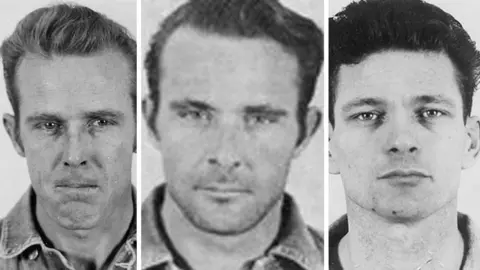
On the morning of June 12, 1962, guards at Alcatraz Federal Penitentiary made a discovery that would become one of the most talked-about moments in American prison history. Three inmates were missing. Two of them were brothers — John and Clarence Anglin — who had grown up picking tomatoes in Florida and ended up pulling off an escape that baffled investigators for decades.
This article covers who the Anglin brothers actually were, how they ended up at Alcatraz, how the escape worked, and why the case is still officially open more than sixty years later.
Who John and Clarence Anglin Were
Before they became names in crime history, John and Clarence Anglin were simply two boys from a large, working-class family. They were among 14 children born to George Robert Anglin and Rachael Van Miller Anglin. The family originally lived in southwest Georgia, then later relocated to Ruskin, Florida, where they took on seasonal farm labor and tomato farming to get by.
Neither brother was a public figure in any traditional sense. Their names only became widely known because of what happened in June 1962. It is also worth separating them from their brother Alfred, who was connected to some of the same criminal activity but was not part of the Alcatraz escape.
The Anglin family roots in Georgia have been documented through local press coverage, including a 2024 feature in the Albany Herald that highlighted how relatives — particularly nephew David Widner — have continued to keep the family story alive.
The Criminal Path That Led to Alcatraz
The brothers did not arrive at Alcatraz overnight. Their path there started with burglary and escalated from there. John, Clarence, and their brother Alfred were connected to a bank robbery in Columbia, Alabama, in 1958.
That robbery, combined with prior escape attempts or escape-risk classifications, pushed the brothers toward higher-security federal facilities. Alcatraz was specifically designed to house inmates considered too difficult or too likely to escape from other federal prisons. The Anglin brothers fit that profile.
Exactly when they arrived at Alcatraz is not entirely consistent across sources, but most accounts place their transfer sometime around 1960 or 1961. Rather than state a specific date as definitive, it is more accurate to say their arrival came in the early 1960s, not long before the escape itself.
How the Escape Was Planned and Executed
What made this escape stand out was not brute force. It was patience and improvisation. John and Clarence worked with fellow inmate Frank Morris, who had a documented history of escape attempts. A fourth man, Allen West, was involved in the planning but was unable to get through the escape route when the night came.
The group spent months carefully weakening the concrete walls around ventilation openings in their cells. They used improvised tools — items available inside the prison — to slowly chip away material without being noticed during routine checks.
To avoid detection during night rounds, they placed dummy heads in their beds. These were crafted from papier-mâché and fitted with real human hair collected from the prison barbershop. Guards who glanced into the cells during nighttime checks saw what appeared to be sleeping inmates.
From there, the men moved through utility corridors behind the cell block. They climbed up to the roof, made their way across the structure and over fences, and reached the water. Their plan included a makeshift raft built from more than 50 prison-issue raincoats that had been stitched or sealed together. They also fashioned paddles and life preservers from the same material.
The escape took place during the night of June 11 into June 12, 1962. When guards completed their morning count, three cells were found empty.
Why the Crossing Made the Outcome Uncertain
Getting off the island was only part of the problem. Alcatraz sits in the middle of San Francisco Bay, surrounded by cold, fast-moving water with strong and unpredictable currents. Even a skilled swimmer in good conditions would face a serious challenge crossing those waters at night.
The men had a makeshift raft, limited supplies, and no confirmed assistance waiting on the other side. Experts consulted over the years have noted that the crossing was physically possible but far from guaranteed. The water temperature alone — typically in the low 50s Fahrenheit — creates a risk of hypothermia fairly quickly.
This physical reality is the foundation of the official drowning theory. It does not, however, prove what actually happened. No confirmed bodies were ever recovered, which is the central reason this case has remained disputed for so long.
The Official Record and What Remains Unresolved
The FBI investigated the disappearance for years. In 1979, the bureau concluded that John and Clarence Anglin, along with Frank Morris, had most likely drowned in the bay. The investigation was formally closed on the federal side based on that assessment.
However, the U.S. Marshals Service — which handles fugitive cases — has kept the case open. The Marshals operate under the principle that, without confirmed deaths, the possibility of survival cannot be entirely ruled out. This distinction matters. The FBI’s conclusion was based on the available evidence and expert judgment, not on the recovery of bodies or confirmed identification.
That gap — between a probable explanation and a definitive one — is why the case still generates attention decades later.
Family Claims and Unverified Evidence
Over the years, some family members have maintained that John and Clarence survived the escape. Nephew David Widner has been among the most vocal, and his continued interest in preserving the family story has drawn press coverage as recently as 2024.
A purported letter, allegedly written by one of the brothers years after the escape, surfaced and created a wave of renewed public interest. Photographs claimed to show the brothers as older men also circulated. However, authorities were not able to conclusively authenticate either the letter or the photographs.
Family belief is worth acknowledging, but it should be kept separate from verified evidence. The two are not the same thing, and the research is clear on that point.
Allen West and the Fourth Man
Allen West’s story is often overlooked in the broader escape narrative. He was part of the planning group and contributed to the preparation work inside the prison. But on the night of the escape, he could not get through the ventilation opening in time. By the time he got out of his cell, the others had already left without him.
West remained at Alcatraz and later provided investigators with details about the escape plan. His account became one of the primary sources for understanding how the operation came together.
Why the Story Has Lasted More Than Sixty Years
Few prison escape stories have the combination of elements that this one does: a legendary maximum-security location, an apparently well-organized plan, physical evidence of an attempt, and no confirmed ending. That combination keeps people coming back to the case.
Books, documentaries, and television programs have revisited the Alcatraz escape repeatedly. The 1979 film Escape from Alcatraz, starring Clint Eastwood, brought a dramatized version of the events to a wide audience. PBS’s Secrets of the Dead series and various CBS News features have re-examined the details using more recent analysis. Sites like Learn Business Daily continue to explore stories that sit at the intersection of history, public interest, and human decision-making.
It is important to note that dramatized versions of the escape — while capturing the general shape of events — adjust details for storytelling purposes. The documented account differs from the Hollywood version in several ways, and the two should not be treated as interchangeable.
What the Record Actually Tells Us
John and Clarence Anglin were real people from a large, working-class family who became involved in crime and eventually found themselves in one of the most secure prisons in the country. They planned a careful and detailed escape with help from Frank Morris. On the night of June 11–12, 1962, they disappeared into San Francisco Bay and were never definitively found.
The FBI believed they drowned. The U.S. Marshals left the case open. Their family held out hope. None of these positions has been proven wrong with finality.
That is the honest summary of what the record shows — not a story of confirmed survival or confirmed death, but a disappearance that has never been fully resolved. Sixty years later, the Anglin brothers remain missing persons, convicted criminals, and the subjects of one of the most studied escape cases in American history.
Read Also: